
“There’s no such thing as bad publicity, as long as they spell your name right”
- P.T. Barnum (a showman, an owner of the Barnum and Bailey circus, and the inspiration for the musical “The Greatest Showman”)
When an election rolls around in the United States, politicians seem to take this philosophy to heart and twist everything in their favor. How is it working in this particular election though? And how much can a candidate say before crossing too many boundaries? To answer all of these questions, one must first understand the past.
Animals, Uncle Sam, and Santa Claus
Would you believe it if someone claimed that the same man managed to assign an animal to each political party, create Uncle Sam, and design the first modern portrayal of Santa Claus? One man did all of it, and his name is Thomas Nast. He was born in Landau, Germany in 1840. (A fun fact about him is that he always celebrated his birthday on September 27, and it wasn’t known until the release of his birth certificate in his biography that his actual birthday was on the 26th of September). Nast grew up in the city of New York in the 1840s and 50s, and many historians claim that he was severely bullied. In fact, the consistent theme throughout almost all of his work is hate towards bullies and sympathy towards the victims. Thomas Nast grew up to be America’s first great political cartoonist and one of the nation’s most influential journalists; over the course of his life, he swayed five different elections and made fun of numerous administrations. When Nast worked as an artist and writer in the Harper’s Weekly (the nation’s leading illustrated newspaper at the time), his cartoons always had anywhere between half a million to more than a million viewers – which led to his immense fame. He was a leading force in voting and held the entirety of public opinion in the palm of his hand. Unlike most other journalists during his time, he did not even attempt to stay neutral: his opinions were made abundantly clear by his cartoons. In addition, his political artwork was nowhere near the simple, clearcut designs of others; his cartoons had so much detail that it was known to take readers several moments just to understand all of the minute aspects. While he remained in fame, glory, and power during the Civil War, Reconstruction, and Gilded Age, the karma of his lack of mercy towards the people he disliked finally caught up to him in the last couple of years of his life. He was increasingly ill, and due to a lack of momentum his career was over. Nast lived a very fulfilling life, and his impact reigns throughout the world of journalism. More authors are willing to acknowledge contrasting opinions, and even more allow their own personal ideals to seep into their work. While his two most famous creations are the Democratic donkey and the Republican elephant (centered in the political world), his impact gave free speech an entirely new definition.
The Democratic Donkey
In 1828, Andrew Jackson (esteemed veteran of the War of 1812, former member of the U.S. House of Representatives, and former member of the U.S. Senate) ran against John Quincy Adams (who previously worked under a president and helped negotiate the treaty that ended the War of 1812). Jackson’s opponents publicly called him a “jackass” (which can also be used to refer to a donkey). Instead of letting the disrespectful comment bother him, he took it in stride; in fact, he was so amused by it that he began to include a picture of a donkey in his campaign posters. That same year, Andrew Jackson won the election against John Adams and went on to serve as America’s very first democratic president. In this case, negative publicity went on to serve him in the end. Later in the 1870s, Thomas Nast drew cartoons depicting the democratic party as donkeys – which helped the animal become a symbol for all democrats.
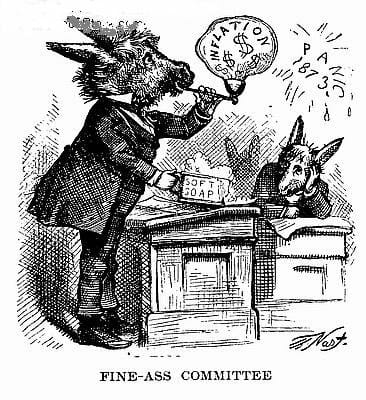
The democratic donkey is almost always portrayed as standing on the edge of complete financial/economic ruin. (Some people believe that the word “nasty” originated from the name Nast; although this is not true, Nast’s ruthless comics almost make people want to think otherwise). Nast was a firm supporter of the Republican Party for almost all of his life and career, and he was always quick to bring the opposing party down.

Once again, Nast’s commentary gave people the news in a controversial manner.
The Republican Elephant
The Republican Party came into existence in 1854, and six years later Abraham Lincoln was elected into office as the very first Republican president. During the Civil War, the phrase “seeing the elephant” meant going into combat. Because of that phrase, some political cartoons had previously been made with the elephant representing the republicans. None of these cartoons, however, were popular until Thomas Nast created one. In 1874, the New York Herald (very democratic at the time), compared republican president Ulysses Grant to Julius Caesar for hinting at running for a third term. While there was no law against this at the time, it was still frowned upon by many. Thomas Nast – who idolizes Ulysses Grant – sketched “The Third Term Panic”. In it, he portrayed the New York Herald as a donkey in a lion costume braying, the republican vote as a nervous elephant stampeding, and the political atmosphere as a group of rowdy animals.
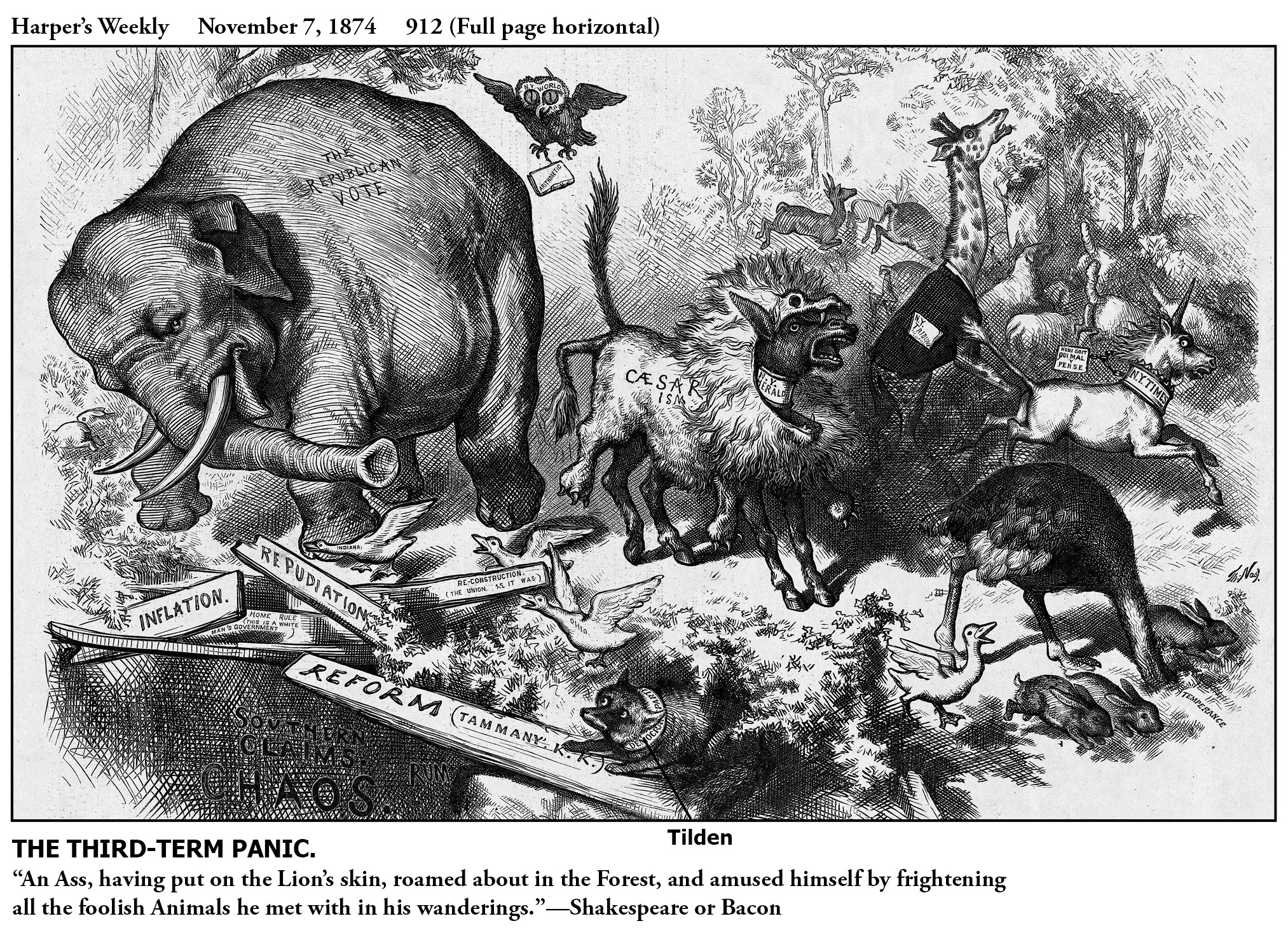
From that point forward, the republican party proudly wore the emblem of an elephant and even officially named the elephant their mascot. (The democrats did not, on the other hand, make the donkey their official symbol). Thomas Nast with his undying affection for the republican party and Ulysses Grant thought there was no choice more perfect than the elephant to represent the republicans. In his words, it was large, dominant, smart and usually well behaved, but stampeded out of control when frightened. He also noted that it had thick skin similar to Grant at that time. (Grant did not end up running for a third term because he did not win the nomination).
Conclusion
Throughout history, this same idea of politicians twisting negativity into fueling their success is apparent. If Andrew Jackson had taken the rude name-calling to heart, there’s a possibility that he would not have won the election at all. Also, if republicans did not capitalize on their depiction as an elephant, they would not have been able to win so much favor amongst the people. Even more so, none of this would have happened if Thomas Nast didn’t become a political cartoonist with so much influence. Additionally, the power never corrupted him, and Nast continued to publish works that stayed true to his ideals. Although Thomas Nast boosted numerous presidential candidates’ popularity, his portrayals of both political parties were more often than not insulting and mocking. Rather than shutting his career down, in the spirit of free speech and expression, the politicians joined him in his mocking. This action of allowing someone to speak openly against the foolishness of the government is found in a very few other places; it is this willingness to hear constructive criticism that ensures that America won’t be driven to the ground quite so soon.
Why is this Important?
This election year is unlike any other in American history. While there are so many weighty issues hanging above each candidate and political party’s heads, both sides are instead choosing to discuss the matter of laughing. Kamala Harris recently went viral for a number of reasons, one of them being her hearty laugh. During several of her campaigns and speeches, her laugh is heard frequently interrupting her statements. In response, Donald Trump nicknamed the democratic candidate “Laffin Kamala”. Trump claimed, “She’s crazy. She’s nuts,” at a rally in Michigan and indirectly labeled Kamala’s laugh as maniacal. While some supporters of Trump saw it as merely a simple joke, comments made by JD Vance say otherwise. Vance in an interview stated that all women in the democratic party are “childless cat ladies who are miserable at their own lives”. Additionally, there were also instances in the Clinton vs. Trump election where he also made fun of her laugh. In all truthfulness, is this really just a joke or is it right-wing sexism? Either way, Kamala Harris’ laugh is bringing her immense fame, and she states that she’s not afraid to be herself. On the other side, democrats are questioning why Trump is never seen laughing. Trump’s niece claims it’s because Trump believes that laughing loudly in public is a sign of vulnerability. He’s often heard making jokes about becoming a dictator without laughing at all; this leads some to believe that he isn’t joking in the first place. His supporters argue that people need to have a better sense of humor. These back and forth attacks from each party are unchanging through all US politics. From the 1800s to present day, the democratic and republican parties are willing to twist whatever insult that’s thrown at them into clever means to increase their own support. Once again, a good vote can only be made when all of the sides are considered equally. Remember, everyone has a story to tell.
Discover more from Inkspire
Subscribe to get the latest posts sent to your email.
 Inkspire