
Young, ambitious, and genius are the best ways to describe Alexander Hamilton when he single-handedly defined the future of the American economy. How much of what he created still exists? And was he truly that far ahead of his own time?
Hamilton on the Rise
Hamilton – unlike the other Founding Fathers – was not born in America. Rather, he was born on an island in the West Indies called Nevis. He left the West Indies in October of 1772 to try his luck in the American colonies. Hamilton being the political and economic genius he was quickly rose to have a lead role in the American Revolution. He also fought in the War of Independence alongside George Washington. After the war, America was left severely in debt with 11.7 million (2.4 trillion today) in debt to France and the Netherlands and 42.4 million (8.7 trillion) in debt to the colonists. One of the first legislative assemblies of the colonies printed money to try and raise funds for the war. This money depreciated rapidly and was only worth 1/40 of its initial value. After the confederation of American states fell apart due to differences between the regions, the Constitutional Convention met up to propose changes to fix the new problems that arose after the war – one of these issues was severe inflation. To the surprise of many, politicians in the meeting decided to write a constitution and change the entire form of government entirely. Hamilton was one of the key members in this meeting. As a staunch Federalist (someone who believes the central government should have more power than the individual states), he helped write the Federalist Papers which contributed to the ideas of the new American government. The new constitution called for a president, and the responsibility was unanimously handed to George Washington. Washington began to establish a cabinet with secretaries of state, war, and treasury. The treasury would also be the most important department because the economy had the most pressing issues; it already had 40 employees when Washington began looking for a Secretary. He initially asked Robert Morris, but Morris declined because he was more interested in making money. Morris recommended Hamilton though. Hamilton used to fight alongside Washington in the revolutionary war, and the president eagerly invited him to be a part of his cabinet. Hamilton quit his law practice to take the job and started working on his famous three part plan as if he had been preparing his entire life to improve America’s economy.
Economic Plan Part 1
On his first day on the job, Hamilton negotiated a loan of $50,000 from the Bank of New York to keep the government afloat. In his first week, he created the customs service to collect a 5% import tax passed by congress and organized the coast guard to prevent smuggling. No one could argue that Hamilton had big plans for America, and he would get it done. His first major proposal was for the new government to refund all of the debts incurred by the old government during the war. There was really no choice because repaying debts was inevitable. The only uncertainty in this whole ordeal was who would benefit from this plan. On January 14, 1790, Hamilton released The Report on the Public Credit which called for redeeming the national debt and issuing new bonds to pay for it. New York speculators and traders got news of this first and quickly bought out all of the old bonds. Many people opposed this plan because they thought it was unfair that wealthy New Yorkers got to buy bonds for a cheaper price from patriotic people who sold them only when they had no other choice during the war. Hamilton eventually shut down all arguments against speculation because he knew that America needed to establish public credit and grow its liquid capital for investments. America promising to pay back its people increased European nations’ faith in the United States, and they began to invest in America as well, multiplying the capital. The idea of Hamiltonianism (the belief that the rules determine the nature and outcome of the game) began to grow. Looking at today’s economy, government bonds are still one of the most stable forms of investment with an almost 100% guaranteed profit. Americans can also use national bonds as collateral for loans. Overall, the first part of Hamilton’s plan was a smashing success, and the United States’ economy was quickly rising.
Economic Plan Part 2
The second part of Hamilton’s plan was for the federal government to assume all state debts. The main opposition to this proposal came from states like Virginia and North Carolina who had already paid off their debts and didn’t want to pay taxes to help other states pay off theirs. In this time, states were still relatively disunited. New England, on the other hand, who had suffered the most during the war desperately needed for this plan to be passed. Hamilton’s plan was vetoed in congress five different times with such a narrow margin that he couldn’t help persisting. Finally, he gave up after the fifth rejection and abandoned his mission for the federal government to assume state bonds, but he still wanted to replace state papers with federal bonds. All state papers were owned by rich aristocrats who would only support the central government if it served them in return. Hamilton wanted them to have large assets in federal bonds, so they would want the federal government to prosper. He still needed a few more votes to pass the bill; being the he spoke to Thomas Jefferson – another Founding Father – over dinner. Every single state representative wanted the capitol to be in their own state. Hamilton was much less tied to the land than the rest of them because he wasn’t born in America, so he offered to move the capitol to Pennsylvania if Jefferson switched votes to support Hamilton’s proposal. Jefferson agreed, and the capitol was in Philadelphia for ten years. As mentioned above, Hamilton wanted the wealthy people of every state to have large stakes in the government. This is due to an idea still prevalent today called the Invisible Hand Theory. The term was coined by English economist Adam Smith to explain how individuals acting out of self-interest can grow the economy significantly. Hamilton was well-versed in Adam Smith’s ideas when he set the stages for the great American economy, and those same ideas continue to keep the economy of numerous democratic nations afloat.

Economic Plan Part 3
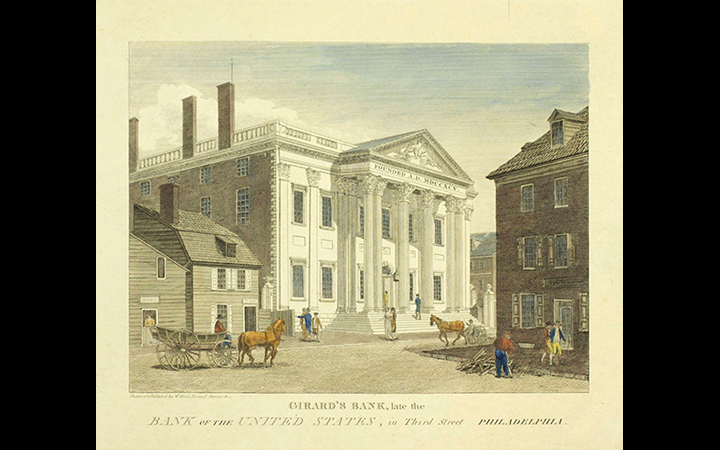
The third part of Hamilton’s economic plan was to create a central bank modeled after the Bank of England. Hamilton was fond of the British, and this is seen repeatedly when he tries to model America’s economy and government after England’s and when he favors England in matters of foreign policy. The central bank would be a place to deposit money, to transfer money to other countries, to obtain loans, and to regulate the money supply. All of these ideas were nothing short of revolutionary in Hamilton’s time. Overall, he wanted to increase efficiency and make more money for America through the bank. Another issue the bank was meant to solve was the issue of currency. The colonies used to use Spanish currency, but since gold and silver were in short supply they needed a replacement quickly. Hamilton knew the government issuing paper money would lead to inflation – the Continental Congress proved that; instead, he created a bank that would be a joint public-private organization. This meant that the independent central bank could maintain currency and discipline, but fearing corruption Hamilton also put twenty government officials on the bank board and made sure the Secretary of Treasury can inspect the books at any time. Congress passed the bill, but the entire nation was split sectionally on the matter. The north supported it while the south opposed it. Hamilton believed that the bill should have been passed unanimously because of how well thought out it was, but he was corrected when Thomas Jefferson and some others wrote to Washington calling the bank unconstitutional, tyrannical, and corrupt. They thought the government should only do what the constitution explicitly stated, and the creation of a bank was not mentioned anywhere in it. Washington was afraid that a bank being created in New York would take the capital away from his own state and announced that he would only pass the bill if Hamilton overcame Jefferson’s argument. Once again, Hamilton the political genius countered by stating that the constitution ordered the government to serve people and that Congress has the power to decide how to serve them. His argument created the term Implied Powers. The bank was created, and from that point forward every single president would use implied powers when troubles arose during their term.
Why is This Important?
Hamilton proves numerous things that current political leaders and voters would be wise to revisit.
- Taxes can greatly benefit the nation if they are used wisely because they fund all of the jobs the government is required to do and bonds the entire nation together. Hamilton knew this when he gave congress all taxing power and America quickly surpassed every single European economy in just a few years.
- The constitution is a living, breathing document that will be subject to numerous changes throughout its life; just because something is not mentioned in it does not mean it is unconstitutional. For example, these implied powers are what allowed Roosevelt to get America out of the Great Depression. Imagine what would’ve happened if implied powers weren’t established by Hamilton?
- Great politicians value intelligence over loyalty. George Washington surrounded himself with the best of the best – including Jefferson and Hamilton who argued over everything. Although Washington sometimes disagreed with Hamilton, he knew it was more important for the nation to be led by the most qualified people rather than the people who support him the most.
Hamilton’s tale lives on. Although he didn’t get to witness the American economy fully prospering, pieces of him live on through public credit, taxes, and central banks. Remember, everyone has a story to tell.
Discover more from Inkspire
Subscribe to get the latest posts sent to your email.
 Inkspire