
The Missing Piece
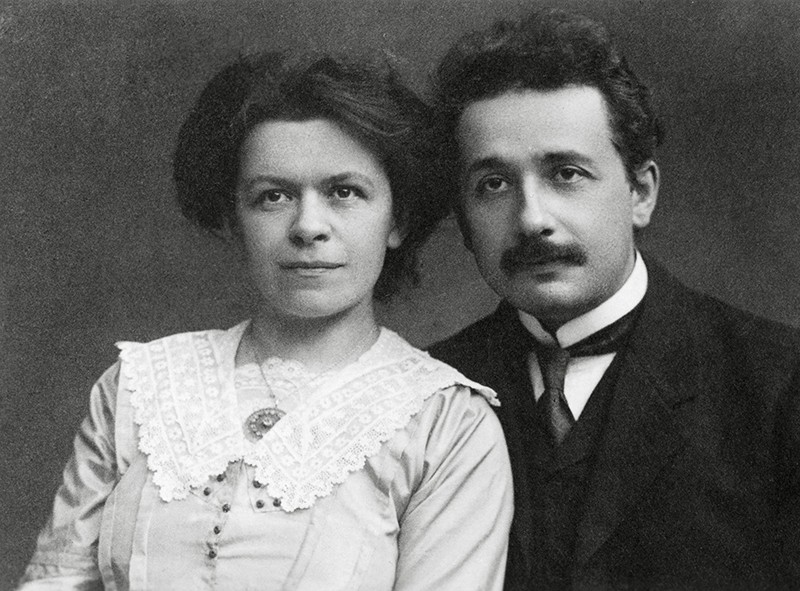
The entirety of something cannot be understood without first acknowledging every single one of its parts, yet the authors of history conveniently erased half of the truth to make it more digestible and easy to weaponize. Now, you may ask, what is that missing half? Women. The contributions of women have been buried in history for centuries, but they are slowly being uncovered through further examination. A small piece of this is the story of yet another woman that was forced to live under the shadow of a man to have her thoughts and ideas published. This is the story of Mileva Marić: Serbian physicist, first wife of Albert Einstein, and the cofounder of the theory of relativity.
Mileva’s Background
Mileva Marić was born on December 19th, 1875 in Serbia. Her parents were relatively well-off, so they were able to give young Mileva an education that most girls at that time were not allowed to have. In the late 19th and early 20th century, women were still regarded as second-class citizens. While the rich had the means to work around this, the poor often dealt with the full brutality of sexism. The changing political and social atmosphere during this time period made it so that Mileva just barely got her high school education; the year after she joined, women were no longer allowed in high school classes. Luckily, her father pulled some strings in 1892 and managed to receive special authorization from the Minister of Education to allow Mileva Marić to attend physics lectures initially intended for boys only. Marić completed her high school career in Zurich in 1894. According to her classmates, Mileva Marić was brilliant, on the quieter side, persevering, and ambitious. On the other hand, Albert Einstein was born in 1879 (four years after Mileva). Young Albert was known for being curious but very rebellious and undisciplined. He, therefore, could not handle the rigor of German schools, so he finished his high schooling in Switzerland.
Mileva Marić and Albert Einstein
Albert Einstein and Mileva Marić both joined the Polytechnic Institute in Zurich to study physics in 1896. Forty-three letters from Albert but only ten letters from Mileva to each other from 1899 to 1903 during school holidays have been preserved. The letters reveal that Albert often sought out help from Mileva to get his school work done and that they cooperated on physics problems throughout their college years. At the end of their school year in 1900, Mileva ended with a 4.7 while Albert got a 4.6 out of 5. Oddly enough, considering that history calls Albert one of the greatest physicists, he only managed to get a 1 in applied physics while Mileva got the full 5 points. It was common knowledge at the school that Mileva shined in experimental work while Albert missed the mark. In the oral exam, however, the professor who might have been biased against Mileva for being a young woman with so much potential allowed the rest of the male students to pass with flying colors while Mileva failed. Sadly, Mileva Marić was not allowed to get her degree.
While the two grew closer, Albert’s family were strictly against their relationship. Albert’s mother thought Mileva was too old and prejudices against non-Germans had a strong place in her heart. On the other hand, Albert’s father refused to let him marry until he acquired a stable job. They taught lessons on the side to make money and continued to work on their research. On December 13th, 1900, they published their first article. Although throughout their letters they both refer to the article as a combined effort, the article is published under Albert’s name alone. Historians have theorized that this could possibly be due to the fact that having a woman co-author could discredit research.
Mileva’s life transformed when she became pregnant with Albert’s child. He still refused to marry her (even after she begged) and used his unemployment as an excuse. Mileva tried to pass her oral exam again, and once again she was failed by a biased professor. A daughter was born – Liserl – but there is no record of her birth or death (it is assumed that she was put up for adoption). Early in December 1901, Albert got a job from his classmate; he and Mileva finally got married.
During their time living together, Einstein had his “miracle year” (1905) where he published five articles – one of which won a Nobel Prize and another which included the famous E = mc2. The mutual respect and love between them was clear to everyone around them at this time. All was well until Albert started an affair with Elsa Einstein. The affair shattered his marriage with Mileva. She agreed to a divorce in 1919; the contract included a clause that said part of his Nobel Prize money would be given to her as compensation for her crucial part in the research. Mileva continued to struggle financially and barely made a living through the private lessons she offered. In 1925, Albert signed his will saying the Nobel Prize money would go to his sons. Mileva was shocked and opposed it strongly. She considered revealing to the public how much of the mathematical calculations and research was actually her work, but her charity forced her to remain silent. Mileva Marić believed no amount of money was worth ruining the reputation of a man she loved.
Proof of Mileva’s Contributions:
– Mileva wrote: “We will send a private copy to Boltzmann to see what he thinks and I hope he will answer us.”
– Albert wrote to Mileva saying that his friend “visited his uncle on my behalf, Prof. Jung, one of the most influential physicists in Italy and gave him a copy of our article.”
– Albert wrote to Mileva on 27 March 1901: “How happy and proud I will be when the two of us together will have brought our work on relative motion to a victorious conclusion.”
– Peter Michelmore (one of Einstein’s biographers) wrote “Einstein went to bed for two weeks. Mileva checked the article again and again, and then mailed it.”
– Mileva’s brother, Miloš Jr talked about the couple: “When silence fell upon the town, the young married couple would sit together at the table and at the light of a kerosene lantern, they would work together on physics problems”
– Albert said at a party: “I need my wife. She solves for me all my mathematical problems.”
– Eight pages of Albert’s first lecture notes and a letter written to Max Planck are in Mileva’s handwriting

It’s Time
The physics world could not have reached the level it is at today without two brilliant physicists: Albert Einstein and Mileva Marić. So who is the true founder of the theory of relativity? The most likely truth is both of them. It’s time to rewrite the history books and add in the name Mileva Marić because any step forward for one woman is a step forward for all women. She was the first person to see any serious potential in Albert Einstein, and his successes were won off of her hard work. The world would be at a loss without women like Mileva Marić who sacrificed themselves for the benefit of science or the world as a whole, and it’s time for their tales to be told. Remember, everyone has a story to tell.
Discover more from Inkspire
Subscribe to get the latest posts sent to your email.
 Inkspire
I think most things are utterly ridiculous, except this!!! Not bad…
LikeLike